



The Fish's Sixth Sense: How the Lateral Line Decides Whether Your Lure Gets Eaten

If you've ever watched a wahoo materialize from blue water and inhale a lure you didn't see coming, you've watched the lateral line at work. Here's the science behind a sense we don't have — and what it means for the spread you're pulling at twelve knots.
The sense humans don't have
Fish navigate, hunt, school, and dodge predators using the usual five senses — sight, hearing, taste, smell, and touch. But they also carry a sixth one we can't experience directly: the lateral line. Run a finger down the side of almost any fish and you'll find it — a faint stripe running gill-to-tail that looks like a row of stippled scales. That stripe is a sensory organ, and it lets a fish "feel" the water around it in remarkable detail.
Biologists call it distant touch. A fish can detect water movement, pressure changes, and vibration from objects it has never seen, heard, or bumped into. In low light, off-color water, or down deep where sunlight barely reaches, the lateral line takes over as the fish's primary search engine.

How it actually works
The lateral line is built from thousands of tiny receptors called neuromasts. Each one is a microscopic structure with a gelatinous cap — the cupula — sitting on top of a cluster of sensory hair cells. When water moves past the fish, the cupula deflects. The hair cells underneath translate that deflection into electrical signals the brain reads as direction, distance, and rhythm.
Neuromasts come in two flavors:
- Free neuromasts sit on the skin and are tuned to slow, low-frequency disturbances — roughly 2 to 15 Hz. Think of a wounded baitfish twitching just under the surface or a half-cripped ballyhoo wobbling off the rigger.
- Canal neuromasts live inside fluid-filled channels under the skin and bones and are tuned higher, in the 20 to 100 Hz range. These are the receptors that pick up the steady, faster oscillation of a trolled lure or a high-speed jet head.
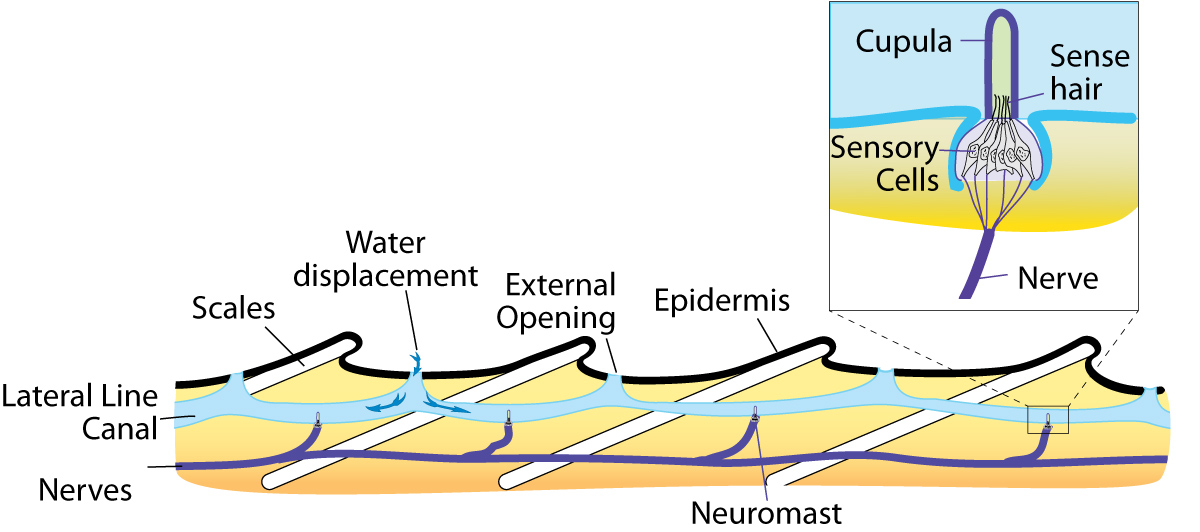
The system is staggeringly sensitive. Fish can register water currents on the order of 0.03 millimeters per second — slower than the convection rising off your hand on a still day. At pelagic speeds, that translates to detecting a struggling baitfish from dozens of feet away, in the dark, with the engines running. Useful, if your business is eating other fish without wasting energy on every wave passing over the boat.
Why your lure has a "fingerprint"
Here's where the biology earns its keep at the end of your spread.
Every lure displaces water in a particular way. The chug of a Hawaiian-style cup-face, the side-to-side track of a tuna feather, the steady throb of a Sevenstrand jet, the swim of a swimming plug behind a planer — each one generates a unique pressure-wave signature. To a wahoo, a mahi, or a marlin lit up in the spread, that signature is as identifiable as a face.
Veteran lure makers and crews have stumbled onto this for decades without naming it. Master rigger Joe Yee in Hawaii is famous for telling clients that a lure has to "sing" the right note from the rigger — he wasn't talking about audible sound. He was talking about a pressure-wave frequency the lateral line of a pelagic predator could read from a hundred feet down.
What's surprising is how little it takes to scramble the signal:
- Swap a stiff hookset rig for a heavier shock-cord assembly and the lure rides lower; its head profile to the water shifts and its wobble frequency changes.
- Re-skirt a chugger with thicker vinyl and you change its pitch as well as its look.
- Two lures of the same model and color, pulled from the same Joe Yee shelf, can run on slightly different frequencies thanks to hand-rigged variation. Captains hand-pick the one that ran hot last season and rig it the same way every time on purpose.
The classic illustration in the offshore world is the difference between a soft-headed slant face — which works a clean, low-amplitude pressure wave at most trolling speeds — and a hard plunger that pushes a much bigger pulse at 8 to 9 knots. Neither is "better." On any given day, billfish are dialed in to one signature and ignoring the other.
The trolled-spread footnote
Offshore crews have lived this for over a century without knowing the receptor diagrams. The reason a chewed-up, half-skirted lure often outfishes a brand-new one isn't sentimentality — it's hydrodynamics. A torn skirt and a scarred head change how the lure pushes water. The pressure wave reaching a wahoo's lateral line through the prop wash is a different signal entirely.
The mid-20th-century Hawaiian and Cairns marlin crews — Henry Chee, George Parker, Peter Bristow, and their generation — were obsessed with the exact running attitude of a lure in the spread. They didn't have the word "neuromast." But they understood that consistency in how a lure tracked, dug, and recovered behind the boat mattered, somehow, more than it should have.

What it means for the way you fish
You don't need a hydrodynamics lab to apply this. A few practical takeaways for the offshore deck:
- Vary the signature, not just the color. If the spread is raising fish that fade off short, the fix is often a different action — a smaller-faced chugger, a swimming plug deeper in the wash, a bait-and-switch teaser pulled at a different speed — not a different skirt color.
- Mind the rig. Heavier leaders, oversized swivels, or a fresh shock cord can quietly change how a proven lure runs at trolling speed. If your confidence lure suddenly stops getting bit, check the hardware before you blame the bite.
- Slow down in dirty water. When sight is compromised — a green push, a tide rip with sediment, an overcast morning at first light — fish lean harder on the lateral line. A lure with a strong, steady pressure wave at moderate speed gives them more to lock onto than a fast-running smoker pattern.
- Don't fix what's running. A lure that hooked fish last trip and now has a chewed skirt, a scuffed head, and a rebuild date on it may be pulling a signature this season's fish have already learned to eat. Resist the urge to "freshen it up." Run it until it stops working.
The bigger point
It's tempting to think of fishing as a contest between your skill and the fish's wariness. The lateral line reframes that. You're not fooling an animal that's bad at noticing things — you're communicating with a sensory system that has been refining its filters for hundreds of millions of years. The fish hears the lure before it sees it. What it hears decides almost everything.
Knowing that doesn't guarantee you raise more fish. It does change which knobs you turn when nothing's working.
Adapted in part from "How Fish Use Their Lateral Line" by Alan Bulmer, originally published on Active Angling New Zealand. Rewritten for the offshore audience at the Science of Fishing.
Cover illustration: Dolphin (Coryphaena hippurus), Atlantic Ocean. 19th-century scientific engraving, public domain. Lateral-line annotations added.



1 comment
Great read